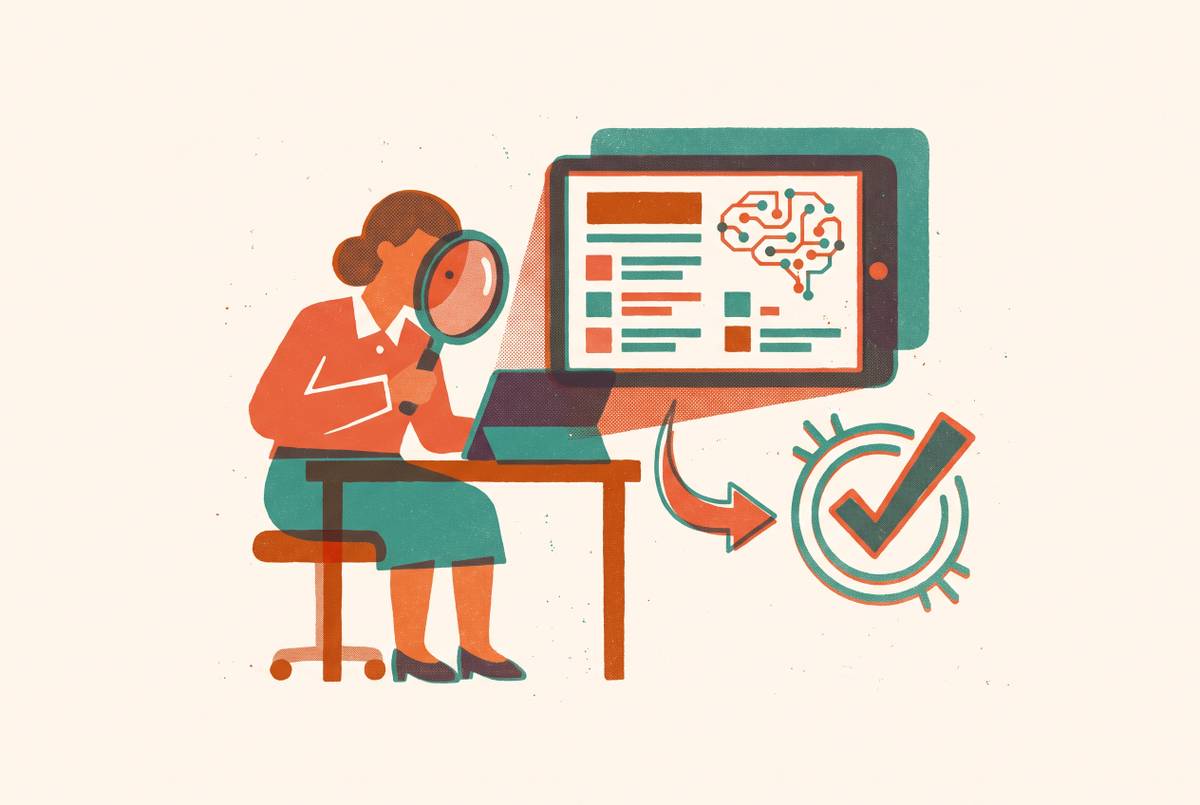
Why Your AP Student Keeps Missing the Same Question Type and How AI Diagnoses the Real Gap
AI reveals the prerequisite skills where your reasoning actually breaks down.

Knowledge gap diagnosis for AP students means finding where their reasoning breaks down. When a student repeatedly misses the same question type, more exposure alone will not repair the faulty step. AI can help by connecting response patterns, explanations, and student questions to the earlier skills those questions depend on, so practice addresses the cause.
Why repeated errors on the same AP question type are a reasoning problem, not a content problem
A student misses an evidence-and-reasoning question in AP History, reviews the solution, then misses another. By the third wrong answer of the same kind, the explanation feels familiar. The student can follow it perfectly well. Yet when the next question comes without a worked solution, the student has the same trouble. That pattern calls for a diagnosis.
The distinction is between recognizing reasoning and producing it. A guided solution gives the student the choices, connections, and order that they must work out on their own under exam pressure. Following those steps does not show that the student knows why each one belongs there. A solution can look obvious once someone else has built it. Finished furniture rarely explains how to use a saw.
This is why repeated errors cannot be understood simply as insufficient exposure to a topic. The student may know the relevant content but fail to use it, or may be trying to execute a process whose prerequisite concepts remain shaky. Those are different problems with different remedies. More content review misses an execution breakdown, while more full-length problems can leave a foundational gap untouched.
How "building stamina for mistakes" turns effort into a trap
Practice strengthens the process being practiced, including a faulty one. Completing more problems without identifying that misconception gives the student more opportunities to repeat it. The effort is real, but its direction is wrong. This is how a determined student ends up building stamina for mistakes.
Scores alone offer little help with that distinction. They show how much went wrong, but not necessarily whether the same reasoning failure produced several losses. When students are under pressure to prepare for several exams, they can fall back on the review that feels most urgent, leaving their gaps unaddressed. A growing stack of completed practice tests then documents effort while leaving their effect on the gap uncertain.
But can't a student just review wrong answers carefully? Yes, if that review locates the point where their own reasoning diverged and explains why. Merely following the official solution does something narrower. It shows how the answer can be reached without necessarily exposing why the student took another route. Practice becomes a problem when it never changes in response to the pattern.
Why the error a student sees on the page is downstream of the real gap
A missed question shows where a weakness came to light. It does not necessarily mark where that weakness began. A student struggling to connect historical evidence to a claim may appear to have a writing problem, while the unresolved issue is historical causation taught three units earlier. Polishing the paragraph would then leave its underlying logic untouched. The symptom has an address, but the cause lives elsewhere.
A prerequisite graph makes that distinction easier to see. It is a map of concepts and the earlier knowledge each concept depends on. If a later skill relies on an earlier one, repeated difficulty with the later skill gives a reason to examine that earlier foundation. This organizes an investigation in which the possible cause of each error still needs examination.
In their paper at the CSEDM Workshop co-located with EDM 2026, Georgia Tech researchers Medhat et al. describe a pipeline that maps the questions students ask onto a curriculum prerequisite knowledge graph. Their study uses questions directed to a conversational AI teaching assistant in a graduate-level AI course. The question patterns reflect topic difficulty and give instructors a curriculum-grounded view of where attention is warranted. When students ask about a topic again, even after it has been taught, those questions can help with diagnosis.
That research has structural relevance to AP prep. Mapping questions onto curriculum dependencies makes it possible to investigate which prerequisite may be causing trouble with the topic a student asks about. For AP prep, that changes the interpretation of a recurring FRQ error. Instead of assuming that the question’s label names the missing skill, diagnosis follows the connections that make the question answerable.
What AI actually reads when a student answers a question wrong
AI diagnosis works from evidence of learning. Depending on the system, that evidence can include sequences of responses, quiz performance, gradebook data, and questions asked during learning. Each reveals something different. A wrong answer identifies an unsuccessful outcome, while a question or explanation may help narrow the uncertainty about how it happened. The distinction prevents “AI diagnosis” from becoming a fancy name for automated marking.
Knowledge tracing is the estimation of a student’s mastery of individual skills from a sequence of responses. Rather than treating each answer as an isolated event, it builds a changing picture of what the student appears to understand. Prerequisite-aware systems extend that picture to the relationships between skills. A later error can then be considered against earlier weaknesses.
Florida Polytechnic University’s ALIGNAgent framework connects knowledge estimation, skill-gap identification, and targeted resource recommendation in one adaptive pipeline. Separate agents handle these connected tasks rather than leaving diagnosis and recommendations in different systems. Its approach includes concept-level reasoning about misconceptions and knowledge deficiencies, followed by learning resources aligned with the identified gaps. The Georgia Tech pipeline approaches the evidence from another direction, mapping student questions to curriculum topics and their prerequisites. Both approaches make the structure of learning part of the diagnosis.
There is a catch that correctness-only systems cannot escape. A student can reach the right answer through flawed reasoning, leaving a misconception hidden until a harder question exposes it. This is the “correct answer trap.” If a tool reads only the final answer, a green tick cannot establish that the reasoning was sound. An honest account of AI diagnosis must distinguish the information a system actually uses from the understanding its interface appears to promise.
How personalized AI feedback breaks the repetition cycle in AP prep specifically
For an AP student, diagnosis should change what they study next as well as what the feedback says. If an evidence-and-reasoning error points to an unresolved concept of historical causation, the next task concerns that concept. A harder or easier version of the same question would not necessarily accomplish this. Adaptation has to reach beyond difficulty.
The student’s experience should change as well. After losing an FRQ point, “review evidence and reasoning” names a category but leaves the student to work out what to repair. Feedback tied to the specific reasoning failure narrows that work. In the historical causation example, it would distinguish a problem with how evidence supports a causal claim from a general problem with writing.
Static review books and generic practice tests still supply explanations and opportunities to practice. What they cannot do by themselves is update the order of study around a particular student’s changing gaps. Adaptive systems can prioritize using exam weight times gap size, so that limited study time goes toward weaknesses with greater potential to affect the score.
The Georgia Tech approach links the questions students ask to curriculum structure, giving teachers evidence of which topics need more work. Applied to AP prep, that principle turns a cluster of similar errors into a question about shared prerequisites. Several students losing evidence-and-reasoning points may need direct instruction on a common foundation. Individual diagnosis can thus inform a classroom decision without pretending to make that decision for the teacher.
What good AI-powered AP diagnosis looks like in practice, and where Passionfruit fits
A topic-level score says where performance is weak, but granular skill-level mastery tracking offers a more precise account of what may be missing. Feedback should say where the reasoning went wrong. Prerequisite-aware sequencing should then connect that diagnosis to the next learning task.
The knowledge model also needs to change as the student works. A diagnosis made from earlier responses should not become a permanent label attached to the student. Continued evidence should refine the picture of mastery and the choice of what comes next. A connected adaptive cycle brings knowledge estimation, diagnosis, and recommendations into one process.
The available material supplies no product-specific evidence for attributing the research systems’ features or results to it. A recommendation therefore has to remain conditional on whether the tool actually provides the diagnostic functions above. A named research framework is not a transferable seal of approval. The useful comparison is between what a tool demonstrably diagnoses and what it merely generates.
For teachers, the distinction extends to the class view. An aggregate score can show that a question type caused trouble, while a diagnostic layer links the repeated errors to prerequisite concepts that may need to be taught. That connection is the relevant capability. Similarly, for a student, generating endless questions is different from identifying why the same question type keeps going wrong. The stronger tool is the one that makes the next study decision more specific.
What students and teachers should actually do differently starting now
The practical change is to treat repetition as a signal to investigate upstream. Before re-drilling a troublesome question type, a student should ask, “At which step did my reasoning diverge, and what would I have needed to know to avoid it?” The aim is a precise repair. Diagnostic AI is useful when it helps locate that repair.
A shared failure on FRQ evidence points is diagnostic data about a skill and how it was taught. AI can surface those patterns, but a teacher still decides what to reteach. The student still has to do the thinking. In the next study session, the useful move is to return to one recurring mistake and identify the first step that no longer makes sense.