Root Cause Diagnosis Tools for AP Exam Mistakes Ranked by Depth of Insight
Deep diagnosis beats surface-level feedback when fixing repeated AP mistakes.
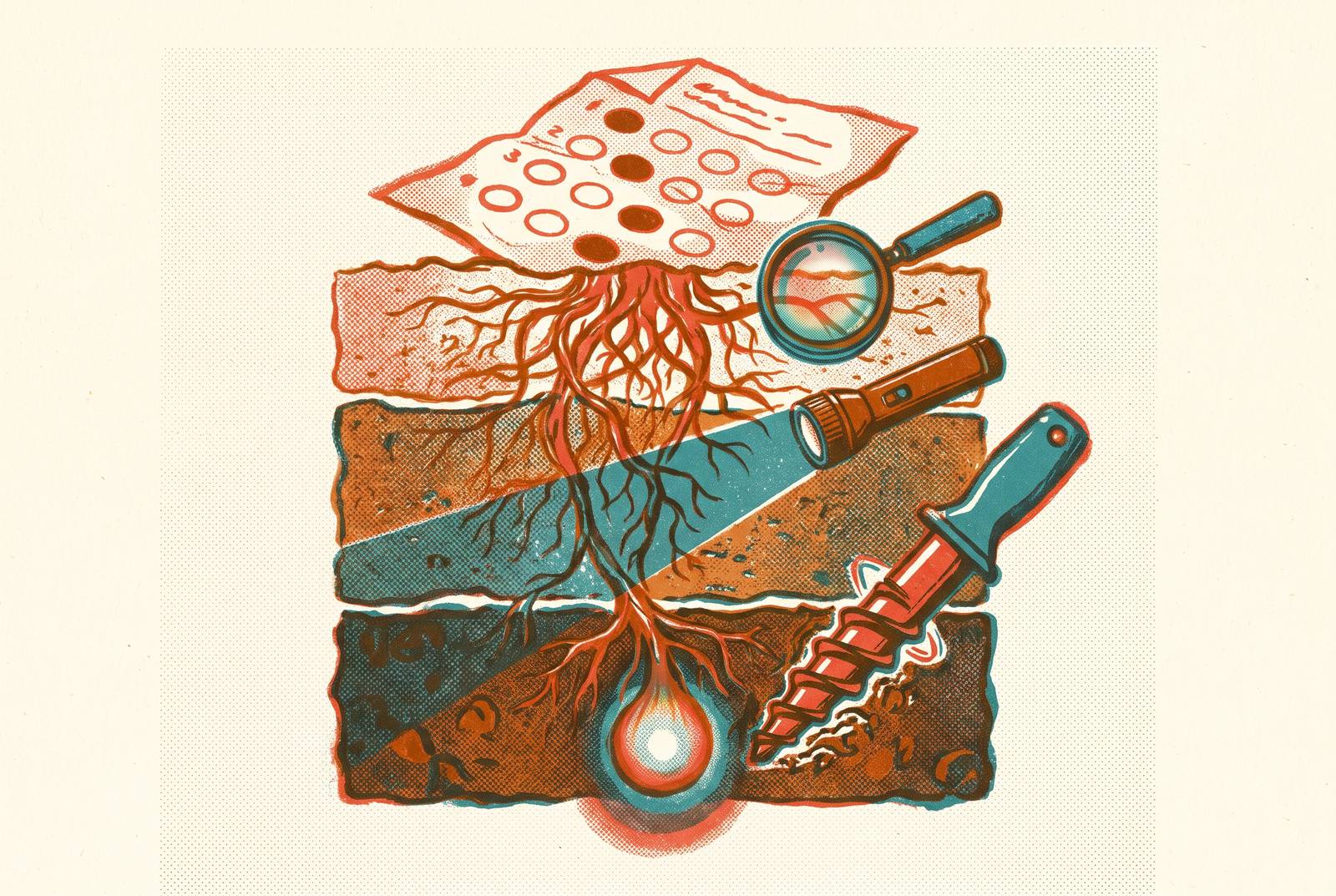
Knowledge gap diagnosis for AP students is most useful when it separates forgotten content from faulty reasoning and missing prerequisites. This ranking orders tools by that depth of insight, from mistake logs to performance analytics to prerequisite graphs. The best choice is not always the deepest tool, but the one that reaches the layer causing the lost points.
Why the same AP score hides fundamentally different problems
A student reviews the explanation, rereads the chapter, and then misses another question that looks suspiciously familiar. The review happened. Why did so little change? Often, the visible mistake and the gap producing it sit in different places. More practice on the visible topic can leave the underlying weakness untouched, like repainting a wall while the pipe behind it keeps leaking.
An overall AP score hides that distinction. Two students with the same scores may need very different help, as one struggles to recall content and the other cannot use a prerequisite skill. AP exams test layered knowledge, so a foundational gap can compound across questions that depend on it. Without a more precise diagnosis, they can spend their review time treating entirely different problems as though they were the same.
What “depth of diagnosis” actually means and why it should govern how students choose tools
Diagnostic depth measures how far back along the causal chain a tool can trace a wrong answer. The surface layer identifies what content was missed. The pattern layer identifies how an error recurs, including whether it looks like conceptual misunderstanding or carelessness. The root-cause layer asks which earlier gap is generating that pattern. Each layer answers a different question, rather than simply providing a longer explanation of the same mistake.
This is a ranking of causal reach. A paper notebook has a definite diagnostic depth, regardless of how carefully its owner keeps it. An AI interface does not automatically reach further because it writes in complete sentences and sounds reassuring. The useful test is whether the diagnosis changes where review should begin. Sending a student back to the right chapter helps with forgotten content, but it does not explain why that chapter remains difficult after repeated reading.
Tier 1 — Mistake logs, flashcard tools, and spaced-repetition apps — what they surface and where they stop
Mistake logs and flashcard-style tools preserve something students otherwise lose, which is a retrievable history of their errors. Aripsy and other mistake-log and flashcard-style tools occupy this surface-level category in the ranking. They are not ranked against one another here. Their shared role is to bring missed content back into view, while spaced-repetition tools schedule re-exposure at intervals designed to resist forgetting. That is useful work when forgetting is the actual problem.
For example, vocabulary in AP Spanish or key dates in AP World History can call for recall practice. A student who cannot remember a term does not necessarily need a theory of why. Sometimes the missing word is just a missing word. Recording it and meeting it again can be sufficient. Treating every recall lapse as a hidden conceptual crisis would make studying needlessly elaborate.
However, the record alone cannot distinguish misunderstanding from carelessness or locate a weakness earlier in a prerequisite chain. A student can supply that interpretation, but the log itself does not. When the underlying concept remains unclear, repeatedly flagging and rescheduling its content leaves the cause untouched. The tool is doing its assigned job. What Tier 1 cannot answer is the next diagnostic question, namely why this same type of error keeps appearing.
Tier 2 — Per-answer AI explanation and performance analytics — diagnosing the pattern behind the mistake
Tier 2 moves from identifying content to classifying errors. Performance analytics can distinguish conceptual misunderstanding from careless mistakes and reveal superficial understanding. The distinction is practical. A student may recognize a concept when an explanation supplies it, yet struggle to deploy it independently under test conditions. Another tour through the definition does not necessarily address that failure.
The mechanism uses more than a tally of correct answers. Practice attempts can supply response time, confidence signals, and error types, from which machine learning models build a knowledge profile. Personalized explanations then identify a reasoning gap. Those capabilities define the tier, rather than a promise that every AI explanation product provides all of them. An explanation of one answer and analytics across repeated attempts offer different amounts of evidence.
This layer is especially useful for recurring multiple-choice errors, where patterns in answer selection can support classification. Free-response questions complicate the picture because a missed point can reflect content, argument structure, or language. Even with a clear classification, Tier 2 has a boundary. It may identify a misunderstood concept without establishing whether that concept depends on an earlier weakness. The diagnosis is sharper, but its finger may still be pointing downstream.
Tier 3 — Knowledge-graph prerequisite tracing — finding the gap that is generating all the others
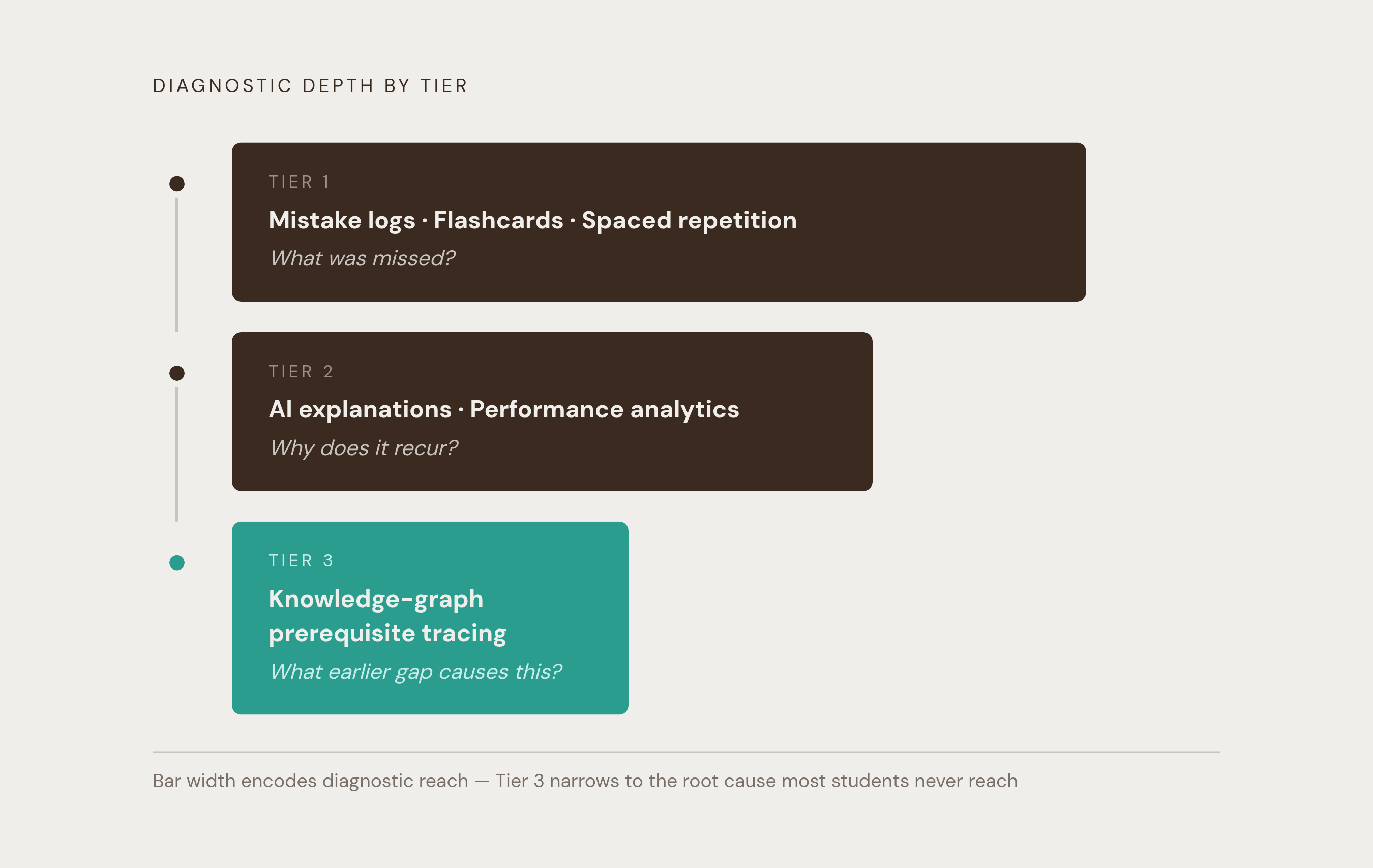
Tier 3 uses a knowledge graph linking topics to their prerequisites to trace a wrong answer backward through the subject. If a failed topic also has weak prerequisites, that topic may be a symptom. The search moves further back. Its aim is to locate the foundational break that explains the later failures, rather than assign more practice wherever those failures become visible.
Math Academy provides this depth for AP math subjects through a knowledge graph handcrafted by domain experts. Each of its topics has several knowledge points, which connect to prerequisites through weighted links. Those weights specify what fraction of a prerequisite is encompassed by solving a problem in the later topic. For AP Calculus, the consequence is concrete. Repeated derivative mistakes may send review toward algebra or trigonometry foundations rather than toward another batch of derivative problems.
The open-source alternative, exam-diag on GitHub, implements Bayesian Knowledge Tracing per concept using a forward posterior and an EM algorithm in pure NumPy. It walks wrong answers up a prerequisite directed acyclic graph to estimate mastery probabilities and identify root-cause concepts. This is a free implementation for students or teachers willing to work with it directly. Its role differs from that of a ready-made study interface, even though the diagnostic logic belongs to the same tier.
That depth depends on a demanding foundation of its own. Math Academy’s graph takes thousands of hours of expert work, which helps explain both its accuracy and the difficulty of extending the approach. The available evidence does not establish analogous graph depth for AP History, AP Language, AP Government, or most AP Sciences. Mathematics offers the clearest case here. A ranking that quietly treats these tools as able to do the same for every AP subject would be ranking a made-up tool.
Why does an AP student keep losing points on free-response questions?
A missed free-response rubric point can have at least three causes, including a content gap, a structural failure in the argument, or a vocabulary or discipline-specific language problem. These require different fixes. Knowing the relevant fact is not the same as placing it in an argument, and placing it there is not the same as explaining its relevance.
Take an AP Government response that misses the evidence-from-founding-documents rubric point. Does the student lack the content they need, struggle to work evidence into the argument, or fail to explain the link in the required language? The lost point alone cannot decide. Rubric analysis can help identify recurring misses, but the response itself must supply evidence for the explanation. Otherwise, “needs more evidence” risks becoming feedback that names the empty space without explaining how it got there.
For writing-heavy subjects, the practical recommendation is to layer rubric analysis with deliberate sub-skill practice in argument structure and evidence integration. The available tools work closer to Tier 2 by surfacing patterns in rubric misses, rather than tracing argumentation through a prerequisite graph. The evidence here does not show that Tier 3 can do the same for AP Government, AP Language, or AP History. That reflects a different diagnostic structure.
How teachers can use class-wide diagnostic data differently from individual students
An individual student needs to know where their understanding broke down. A teacher also needs to know how widely that breakdown is distributed. A short, low-stakes quiz with per-question data can reveal what the class does not know before the next lesson is planned. A full practice exam is not required for that purpose. The first task is discovery, rather than assuming that the class merely forgot whatever the teacher expected it to remember.
The AP Government example changes meaning at this scale. If most of the class misses the evidence-from-founding-documents point, the teacher has a signal about instruction. A shared difficulty with evidence integration calls for a different response from scattered recall gaps. Teachers can use the same rubric point to locate a class-wide bottleneck. That lets the teacher address a common weakness before students move further into work that depends on it.
Wayground, formerly Quizizz, offers teacher-side progress tracking with per-student mastery data from live and student-paced delivery. Its free plan limits student numbers and saved resources. Those constraints affect fit, but the diagnostic purpose remains distinct from individual prerequisite tracing. For a teacher, the useful output is the distribution of gaps across the class. That distribution can guide changes to instruction rather than routing every student separately through a graph.
The real limit of AI diagnosis — where human judgment is still required
Even the deepest diagnostic tool produces a hypothesis that needs testing. A graph can identify weak trigonometry as a probable cause, but it cannot settle unassisted how much review a particular student needs or when that gap has closed. Fluency is not proof, either. A polished explanation can sound conclusive while leaving alternatives unresolved. AI adds value by accelerating error summarization and hypothesis generation.
A student given a prerequisite-based explanation should attempt problems at that prerequisite before treating the cause as established. A student using a mistake log must supply the “why” through reflection or a teacher conversation. With per-answer AI feedback, students should check the explanation against the scoring guidance for that question, especially for free response. Each tier leaves a different piece of the work to its user.
For FRQs, official questions, scoring guidelines, and sample responses remain the benchmark. AI scoring needs human oversight, particularly for complex or subjective answers. Automated feedback can identify a likely weakness, while a final judgment on the response requires human oversight. Students who treat the output as a starting point retain the chance to catch a mistaken diagnosis before it consumes their review time.
Matching the diagnostic tool to the AP subject and the kind of mistake being made
The choice begins with two factors, which are the subject’s knowledge structure and the likely error type. For a first missed attempt on new content, Tier 1 review is often sufficient. That approach can work for AP Biology vocabulary and AP World History key developments when the student has simply forgotten them. More depth is not automatically more useful.
If the same topic keeps failing across practice sessions, the recommendation changes. Tier 2 explanations and analytics can help distinguish recurring conceptual misunderstanding from an isolated lapse. In a sequential mathematical subject, a persistent conceptual error then warrants Tier 3 tracing or a manual prerequisite check. Math Academy has the graph-based option for AP math, while exam-diag has code that users can work with directly if they are willing.
Repeated FRQ rubric misses call for a different choice. Rubric analysis should first sort problems by content, structure, and language, so sub-skill practice can focus on the kind found. A graph designed for mathematics is not a substitute for examining how an argument uses evidence. Another flashcard may also leave a paragraph’s problem unsolved when it has the facts but fails to connect them.