AP Art History Key Works and Periods Most Tested on the Exam
Focus on the three content areas where most exam questions actually cluster.
Most students open their AP Art History prep the same way: 250 required works, one big flashcard deck, equal time for each one. That approach feels fair. It also ignores how the exam actually scores you. The ten content areas carry sharply different shares of the test, so treating each unit the same way is a planning mistake before a single card gets flipped. The exam runs three hours, split evenly between image-based multiple-choice questions and free-response questions, and it asks you for both volume and depth at once. That combination punishes thin, even coverage. Students who know where the questions are concentrated and go deep on those spots score higher than students who spread evenly across all of them.
Content area weights on the exam
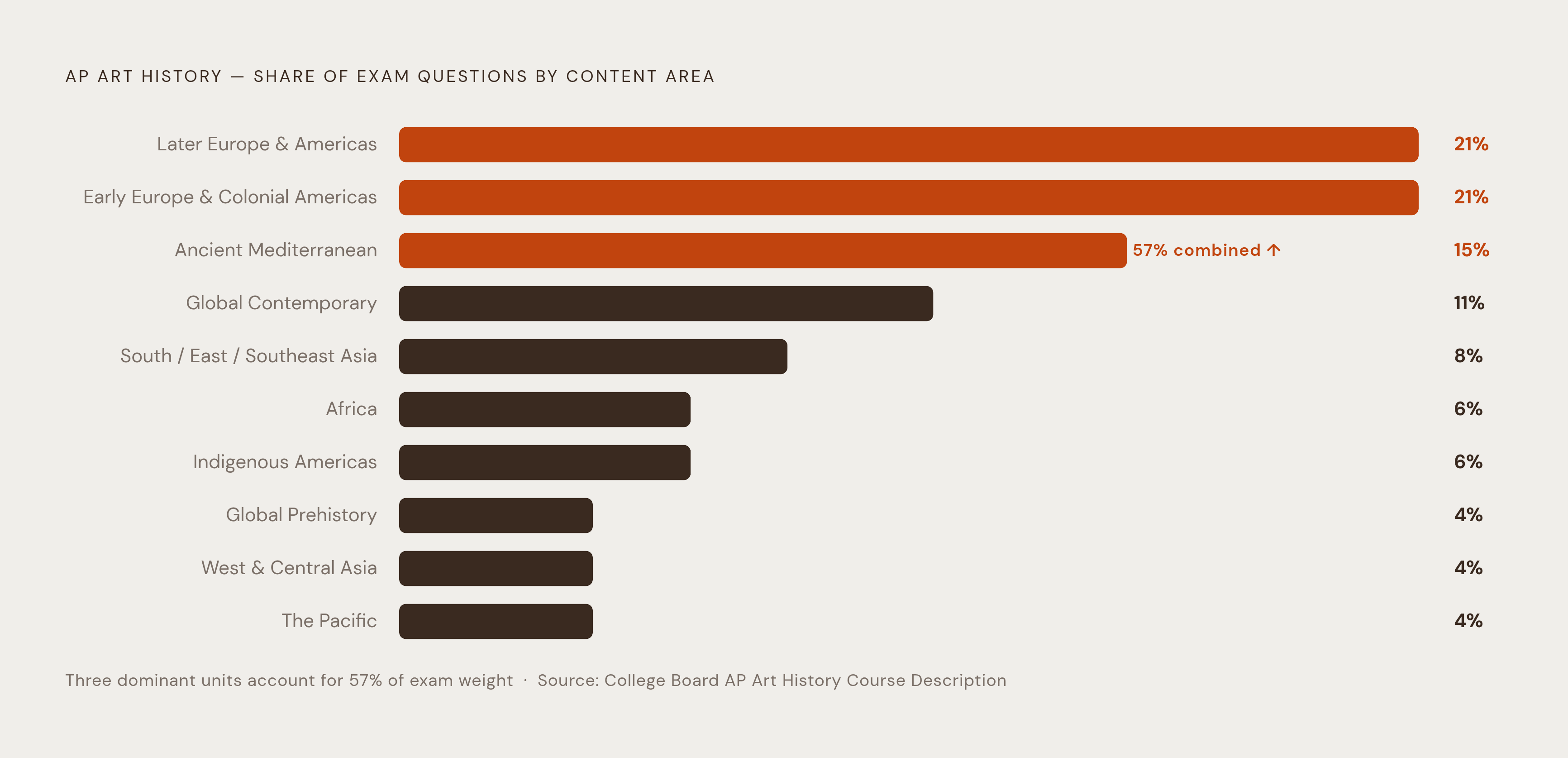
The exam draws from 250 required works spread across ten content areas, but three of them, Ancient Mediterranean, Early Europe and Colonial Americas, and Later Europe and Americas, together make up the majority of all scored questions. That alone should reshape how a study calendar gets built. Global Prehistory, covering 30,000 to 500 BCE, holds about 4% of the exam. Ancient Mediterranean, spanning 3500 BCE to 300 CE, holds about 15%. Early Europe and Colonial Americas, running from 200 to 1750 CE, is about 21%, tied with Later Europe and Americas, which covers 1750 to 1980 CE and is also about 21%. Indigenous Americas, from 1000 BCE to 1980 CE, holds about 6%, the same share as Africa, 1100 to 1980 CE. West and Central Asia, 500 BCE to 1980 CE, holds about 4%. South, East, and Southeast Asia, 300 BCE to 1980 CE, holds about 8%. The Pacific, 700 to 1980 CE, holds about 4%. Global Contemporary, 1980 CE to the present, holds about 11%.
None of this is random. Early Europe and Later Europe each come with 51 required works, the largest image sets on the exam, so it makes sense they pull the largest question shares. Global Prehistory, Africa, West and Central Asia, and the Pacific each have only 11 required works, and the pattern holds: more images in a unit, more questions drawn from it. Global Contemporary breaks that pattern. With only 27 works, it still pulls about 11% of the exam, a share that outpaces what its image count would predict. That makes it worth watching closely, something the next sections return to. The lightest units deserve a place in a study plan, just a smaller one, sized to match the small number of points they actually carry.
The Ancient Mediterranean works that anchor Unit 2's 15% share
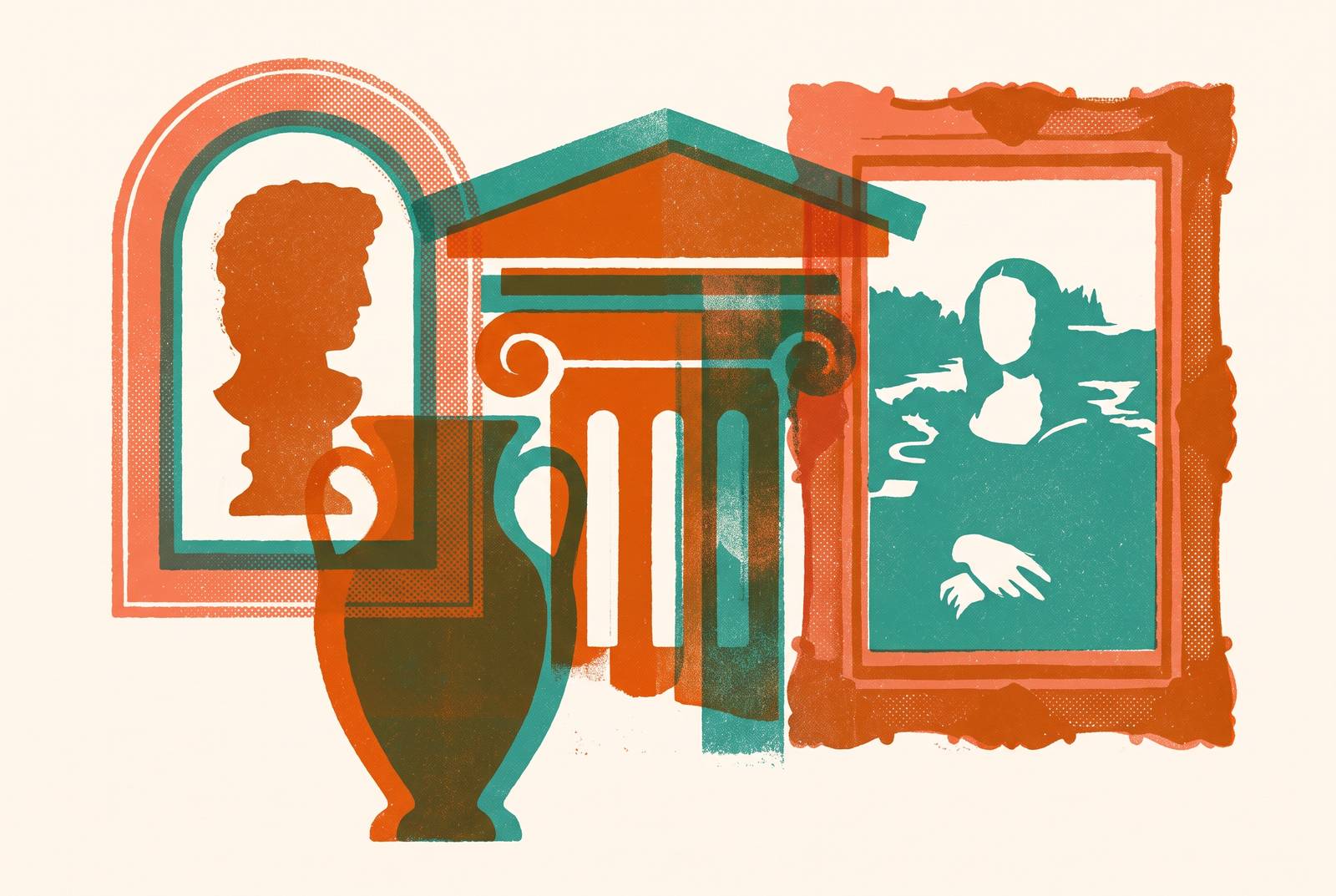
Unit 2 covers 36 required works pulled from Egyptian, Mesopotamian, Greek, Etruscan, and Roman art, and a handful of them appear repeatedly on both multiple-choice and free-response questions. On the Mesopotamian and Egyptian side, the Standard of Ur tests how a student reads state power, visual registers, and pictorial narrative. The Code of Hammurabi tests relief carving alongside the connection between law and hierarchy. The Great Pyramids of Giza stand in for monumental funerary architecture and the idea of divine kingship. The Palette of Narmer carries a cluster of concepts on its own: composite pose, hieratic scale, and the unification of Upper and Lower Egypt, and a released practice question set confirms the exam leans on this work specifically to test hieratic scale.
On the Greek and Roman side, a canonical freestanding sculpture is the go-to example for contrapposto, the idealized body, and the Greek canon of proportion. A landmark domed temple carries Roman concrete construction, the oculus, and the shift from temple form to rotunda. The Etruscan tradition is represented by the Sarcophagus of the Spouses, a funerary sculpture made around 530 to 520 BCE, and this one deserves special attention. An official released sample multiple-choice set built five consecutive questions around this single object, covering its culture, medium, type, placement, and subject matter in sequence. That pattern reveals something important about how the exam is built: a single large-format or multi-part work from a high-weight unit can anchor an entire block of questions. Knowing a work's name and date without knowing its full context is riskier on this exam than it looks on the surface.
The highest-yield works inside Early Europe and Colonial Americas, the exam's largest unit by question share
Unit 3 carries the largest required image set on the exam and ties for the highest question share, so more raw points live here than anywhere else, and loose, unfocused studying does the most damage here, since 51 works is a lot to spread attention across evenly. The unit's internal arc starts with Byzantine and Islamic architecture. The Hagia Sophia tests pendentives, dome construction, and the relationship between Byzantine sacred space and imperial power. The Great Mosque of Córdoba tests the hypostyle hall, the qibla wall, the layered double arches, and the building's history as a converted Visigothic basilica. The Alhambra tests muqarnas, courtyard geometry, and the character of Nasrid palace architecture.
From there the unit moves into medieval Christian building and image-making. The Church of Sainte-Foy at Conques carries Romanesque pilgrimage architecture, its carved tympanum, and its function as a reliquary site. Chartres Cathedral tests Gothic structural logic through flying buttresses, its stained glass program, and its portal sculpture. Moving into painting, Giotto's fresco cycle at the Arena (Scrovegni) Chapel tests proto-Renaissance naturalism and narrative built across visual registers. Velázquez's Las Meninas, a Baroque composition, tests the relationship between the viewer's gaze, the mirror inside the painting, and the status of the artist within royal patronage.
One part of this unit gets skipped more than it should: the Colonial Americas works, pulled from Mesoamerica and the Spanish colonial period, sit alongside the European material in the same unit and can surface in comparison free-response questions that ask students to connect across cultures. Comparison questions often reach across traditions rather than staying inside one, so skipping that slice of the unit leaves a real gap.
The highest-yield works inside Later Europe and Americas, the exam's other 21% block
Unit 4 runs from Neoclassicism through the end of modernism. Its anchor works map onto movements the exam tests constantly, by name, in both multiple-choice and free-response questions. David's Oath of the Horatii carries Neoclassical composition, the theme of civic virtue, and its connection to the French Revolution. Goya's The Third of May 1808 carries a Romantic critique of war, built through the formal contrast between the victims and their executioners. Jefferson's Monticello extends Neoclassical architecture into the Americas, drawing on Palladian influence while sitting inside the plantation context that shaped it.
Moving into Realism and Impressionism, Manet's Olympia tests the confrontational gaze of its subject, its challenge to the academic nude tradition, and the class and gender dynamics of Second Empire Paris. From there the sequence moves into later nineteenth-century and early modernist painting: one landscape work tests expressive brushwork and color used as emotional language, while another painting tests proto-Cubism, its debt to African and Iberian visual sources, and its formal fragmentation. The unit closes with Dada and Pop Art. Duchamp's Fountain tests the readymade and the question of what counts as art. Warhol's Marilyn Diptych tests silkscreen reproduction and the way mass media and celebrity intersect with mortality. Students often know these titles cold but struggle to place them in sequence, Neoclassicism to Romanticism to Realism to later nineteenth-century painting to modernism, and that sequencing is what the exam's continuity-and-change question is built to test.
Global Contemporary's outsized question share
Global Contemporary carries a lower overall exam weight than Ancient Mediterranean, but its 27 required works pull a question share that outpaces what that small count would suggest, making it one of the most efficient units on the exam to study per work learned. A handful of anchor works appear repeatedly in both multiple-choice and free-response sections. Maya Lin's Vietnam Veterans Memorial tests landscape, materiality, memory, and the way a visitor's own body becomes part of the work while walking along it. Christo and Jeanne-Claude's The Gates, a temporary public installation built in Central Park, tests site-specificity and the use of public space. Xu Bing's A Book from the Sky, an installation built around an invented script, tests print culture, legibility, and questions of Chinese cultural identity.
Contemporary works also appear paired with ancient or early modern works inside comparison free-response questions more often than students expect. Both the continuity-and-change question type and the contextual analysis question type reward a student who can discuss a contemporary piece on the same formal and historical terms used for something centuries older. Students who skip this unit because the material feels unfamiliar or recent are leaving points on the table that cost relatively little effort to pick up.
The exam's eight tested skills and study depth
Knowing a work's title, date, and culture is the minimum, not the goal. The exam spreads its demands across eight tested skills, and most of them ask a student to do something with an image. Visual Analysis is the ability to identify, describe, and explain formal choices, and it makes up a large share of the multiple-choice questions and also shows up in Free-Response Questions 1 and 2. Comparison of Works of Art holds a smaller share of multiple-choice questions and gets assessed directly in Question 1. Artistic Traditions, which asks students to connect a work to the broader tradition it belongs to, carries a sizable share of multiple-choice questions and is assessed in Question 6. Visual Analysis of Unknown Works holds a smaller multiple-choice share and is assessed in Question 3. Attribution of Unknown Works also holds a smaller multiple-choice share and is assessed in Question 5. Art Historical Interpretations carries a smaller multiple-choice share and gets assessed in one or two free-response questions. Argumentation appears only in Free-Response Questions 1 and 2, with no multiple-choice component.
Contextual Analysis holds the single largest share of multiple-choice weight on the entire exam. A student who can name the Parthenon on sight but cannot connect its sculptural program to Athenian civic identity will lose most of the points tied to that question, even with the identification correct. Artistic Traditions ranks second by multiple-choice weight and ties most directly to period-level understanding, the kind of knowledge that comes from knowing a work belongs to a tradition and not just a single moment in time. Put together, these two skills show why the weighting map from earlier only pays off when you study past flashcard-level identification and into the reasoning behind each work.
The FRQ section is where the exam separates scores, and attribution is its sharpest knowledge-gap test
The six free-response questions carry the same total weight as the entire 80-question multiple-choice section, and they demand a different kind of preparation than recognizing an image on sight. Question 1 is a long comparison essay worth 8 points. Question 2 is a long visual and contextual analysis worth 6 points. Questions 3 through 6 are shorter essays worth 5 points each, covering visual analysis, contextual analysis, attribution, and continuity and change in turn.
Attribution, tested in Question 5, asks a student to identify a work never seen before by reasoning out its culture, period, or style purely from what's visible in the image. Compare a Romanesque tympanum to a Gothic one: the Romanesque version tends toward dense, compressed figures and a heavier, more compact frame, while Gothic portal sculpture stretches figures taller and gives them a more naturalistic stance and drapery. A student who has studied the Parthenon in full depth, its columns, its frieze, its pediment, its proportions, the civic context behind its construction, can take that same reasoning and attribute an unfamiliar Greek temple correctly. A student who only knows the Parthenon's name cannot make that leap. This is where weight-aware study and depth of knowledge meet directly: the three highest-weight units, Ancient Mediterranean, Early Europe, and Later Europe, also contain the largest number of works with stylistic signatures distinct enough to anchor attribution questions. Question 6, the continuity-and-change essay, runs on the same logic. It rewards a student who understands not just what a work is, but how it sits in relation to what came before it and what followed in the same tradition.
Building a study sequence from the weight map
Start with Units 3 and 4, since together they carry a larger share of the exam than any other combination. Inside each unit, work through the anchor works named earlier first. That's not because the other works on the list never appear, it's because the anchors are the ones most likely to carry an entire image cluster or sit at the center of an artistic-traditions question. Once your anchor coverage is solid, let the skill weights decide what comes next. Contextual Analysis carries the largest share of multiple-choice points, so for every anchor work, practice stating its political, religious, or social context out loud, not just its formal features. Artistic Traditions comes second, so practice placing each anchor work inside the arc of its period and explaining how it connects to what came before and after it. Attribution asks for the deepest kind of knowledge of all: the goal isn't recognizing an image seen before, it's reasoning from visual evidence alone to a culture and a period on a work never encountered.
Essay practice pays off most once your content knowledge reaches a real threshold. Writing practice essays on works barely understood produces thin, surface-level answers, while writing on anchor works studied in depth produces the kind of specific evidence and argumentation the FRQ rubrics are built to reward. AI-powered practice tools can score responses immediately and track which content areas and skill types keep producing errors, turning this triage into a systematic process. The question that matters most in review is where the reasoning behind an answer broke down. The exam's structure hands students a map of where the points are, and the only job left is following it.