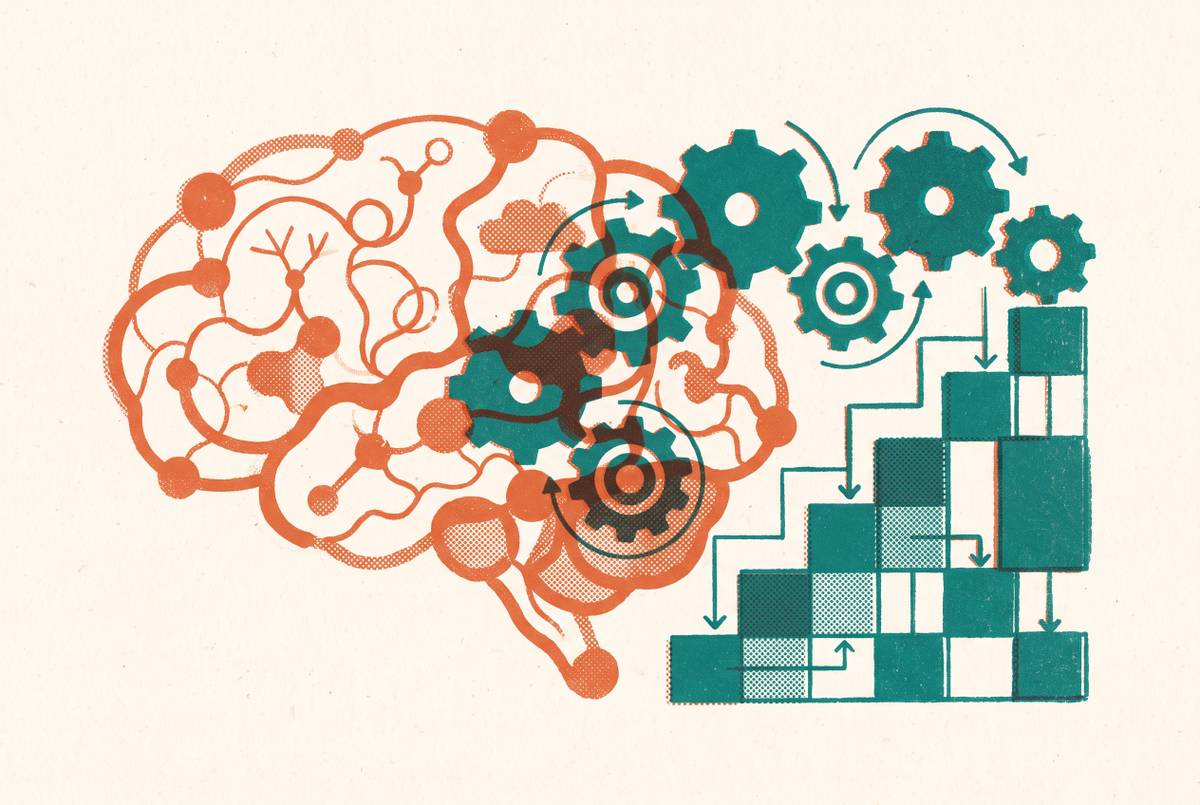
Five Strands of Mathematical Proficiency Explained
The NRC's five-strand framework defines mathematical proficiency as interwoven competencies.

For most of the 20th century, being "good at math" meant being fast and accurate with arithmetic. That definition held up for a while, then it stopped being enough. Later in the century, that definition got bigger. Educators started asking whether students understood the structure behind the math, not just the steps. By the 1980s and 90s, reform movements pushed further still, adding problem solving, data fluency, and the ability to talk through mathematical ideas and results. Every few decades, someone noticed the old definition was leaving something important out, so the definition grew again.
That pattern finally got a name in 2001, when the National Research Council published Adding It Up: Helping Children Learn Mathematics, edited by Kilpatrick, Swafford, and Findell. The book laid out five strands meant to capture, in one unified account, what it actually takes to learn math well. Its mandate was to pull together research on how people learn math, give direction on teaching and curriculum, and speak to teachers, researchers, textbook publishers, policymakers, and parents at the same time. That's part of why the framework spread so far. Common Core leaned on Adding It Up to define what proficiency looks like. Ohio built its Standards for Mathematical Practice around the five strands as one of two foundational proficiencies behind its eight practices. One state cites the NRC's definition of procedural fluency directly in its own math standards, and built instructional strategy around balancing conceptual work with procedural work.
The NRC insisted none of the five works on its own. They're interwoven and interdependent, and no single strand carries more weight than the others. Everything that follows in this piece comes back to that claim.
Why the NRC chose a braid, not a ladder, the interdependence claim explained
The NRC didn't describe the five strands as five stages a student climbs through. They used a different image: a braided rope, where separate strands twist together to hold weight that no single strand could hold alone. Mathematical proficiency, in this picture, depends on knowledge, skills, abilities, and beliefs that all lean on each other.
That has a direct consequence for how the strands are numbered. They develop together, feeding each other as they grow. That braid structure runs so deep that it's often hard to point at a single piece of student work and say which strand produced it. The Colorado Department of Education's framework states the relationship between just two of the strands: conceptual understanding makes procedures easier to use correctly and remember, while practicing procedures can deepen conceptual understanding in return. Keep that image of a braid in mind. It's the frame the rest of this piece builds on.
Conceptual understanding: knowing why, not just what
Conceptual understanding means grasping math ideas as a connected whole, not as a pile of separate facts. The NRC defines it as comprehension of mathematical concepts, operations, and relations. Their fuller description calls it "an integrated and functional grasp of mathematical ideas," one that includes knowing facts and methods, but also why those facts and methods matter and how they link to each other.
Picture a student who can divide fractions by flipping the second one and multiplying straight across, and gets every answer right. Asking that same student why "invert and multiply" works usually produces silence. Conceptual understanding is what closes that gap.
It is visible in action before it appears in words. Schoenfeld's formulation, cited in Corrêa and Haslam (2020/21), draws the line clearly: knowing facts and definitions and running procedures on command is necessary, but it isn't the same thing as understanding, and it isn't enough on its own.
Conceptual understanding also doesn't sit in isolation. Conceptual understanding makes procedures easier to learn, less prone to error, and easier to hold onto, and procedural practice deepens conceptual understanding in return. It also feeds directly into adaptive reasoning: explaining and justifying a solution requires something to explain, and conceptual understanding is the content that fills that explanation.
Procedural fluency: speed and accuracy in service of understanding, not a substitute for it
Procedural fluency gets mistaken for the whole of math ability more often than any of the other four strands, maybe because it's the easiest one to see and score. The NRC defines it as skill in carrying out procedures flexibly, accurately, efficiently, and appropriately. Notice "flexibly" sits right alongside "accurately" and "efficiently" in that sentence. The fuller NRC description makes the same point: fluency means knowing procedures, knowing when and how to use them, and performing them well, not just performing them fast.
This strand covers the basics everyone recognizes: computing with whole numbers, multiplying by multiples of ten, and using mental shortcuts, like noticing that 98 plus 37 is the same as 100 plus 35. A student drilled on one problem format can hit a wall the moment the numbers or the setup shift, even slightly.
The common mistake treats conceptual understanding and procedural fluency as if they're fighting for the same classroom time, when they're actually two closely connected strands reinforcing each other. Kilpatrick and colleagues (2001), cited in Corrêa and Haslam, pointed out that school math has too often rewarded memorizing over understanding. Procedural fluency, as the NRC defines it, keeps procedure grounded in understanding. Knowing which procedure to pick up, and when to set it down, is a separate strand from procedural fluency.
Strategic competence: formulating and representing problems, not just solving them
Strategic competence is the ability to formulate a math problem, represent it, and then solve it, according to the NRC's definition. Formulating is listed first because most classroom instruction skips teaching it.
Most school math problems arrive pre-packaged. The question is spelled out, the numbers are given, and often the exact procedure to use is obvious from the chapter title. The hardest part is figuring out what question to ask in the first place, then deciding which mathematical tools even apply. That's the ambiguity school problems usually strip away before a student ever sees them.
Building strategic competence takes practice with unfamiliar situations, where a student has to try an approach, see if it works, and adjust if it doesn't. It overlaps heavily with mathematical modeling, defined by COMAP and SIAM (2016), cited in the Colorado framework, as using math to represent, analyze, predict, or make sense of real-world phenomena. Strategic competence decides which tool fits the job, while procedural fluency determines how well that tool gets used once it's picked up.
Adaptive reasoning: the capacity to explain, justify, and adjust
Adaptive reasoning is the NRC's term for the capacity to think logically about how concepts and situations connect, to justify a chosen approach, and to explain why a conclusion holds.
A student can land on a correct answer using strategic competence to pick an approach and procedural fluency to carry it out, and still not be able to explain why that answer is right. Adaptive reasoning is what produces the explanation. It's also the reason written-response questions and proof-based assessments exist. Those formats are testing something multiple-choice scoring can't reach.
Even very young students can reason at some level, as long as they have enough background knowledge, the task makes sense to them, and the context feels familiar and worth engaging with. Developing this strand takes time. Corrêa and Haslam (2020/21) point out that math involves thinking, analyzing, and testing out conjectures, and none of that is a straight line. Adaptive reasoning is what lets a student notice the wrong turn and correct course. Reasoning through that kind of uncertainty takes a particular kind of confidence. The next strand addresses that confidence directly.
Productive disposition: the psychological foundation that makes the other four strands possible
Productive disposition is the habitual inclination to see math as sensible, useful, and worth the effort, paired with a belief that steady work pays off and that one is capable of doing math well. The NRC's fuller description spells out all three pieces: seeing sense in math, believing effort leads somewhere, and seeing oneself as someone who can actually do math.
This strand is the condition that lets the other four develop. The relationship runs both directions: students need productive disposition to build conceptual understanding, procedural fluency, strategic competence, and adaptive reasoning, and progress in those four strands is what builds productive disposition in return.
Most kids start school liking math just fine. What happens next depends on what gets reinforced. Without that reinforcement, the other four strands get undermined by anxiety, avoidance, or a quiet belief that some people are "just not math people." Winnetka School District 36 builds this same idea into its own proficiency framework, treating a positive attitude toward math as a core, not optional, part of the picture. Productive disposition isn't the last rung on a ladder after the other four strands are built. It runs underneath and through all of them, the whole time.
How the five strands reinforce each other in practice
The braid is easiest to see when it frays. Productive disposition is what kept the student working through four steps instead of giving up after the first one looked unfamiliar.
Taking any one strand out makes the problem fall apart in a particular way. And a student missing productive disposition may have all four other strands intact and still give up the moment the first attempt doesn't pan out.
The interwoven nature of the strands means it's genuinely hard to look at one piece of student work and say "that's conceptual understanding" or "that's adaptive reasoning," because a correct, well-reasoned solution draws on all five at once. Corrêa and Haslam (2020/21) push this point into assessment: tests that lean too heavily on procedure end up missing most of what the framework defines as proficiency.
Why standard assessments measure only part of the braid
Most assessments test for one strand far more than the other four. Kilpatrick and Swafford (2002), cited in Corrêa and Haslam (2020/21), put it bluntly: most current math tests, whether standardized exams or classroom quizzes, reach only a fraction of math proficiency, usually the computing strand and some simple slices of understanding and application. Corrêa and Haslam add that there's very little research on classroom assessment that actually tries to measure all five strands at once.
That gap shapes how students prepare, often without anyone noticing. A student can score well under that kind of test while strategic competence and adaptive reasoning stay thin and undeveloped, because nothing in the test demanded them.
Written-response formats change the equation. Free-response questions that ask a student to explain their reasoning are, functionally, testing adaptive reasoning directly, the strand that pure procedural drilling never touches. Preparing well for any high-stakes math exam means figuring out which strands that specific exam is actually testing, not just which topics show up on it. For AP exams and similar formats, adaptive reasoning is graded directly.
How targeted, feedback-rich practice develops all five strands, not just the ones tests make easy to measure
Generic drilling, repeating the same problem type over and over, mostly builds procedural fluency and stops there. It can't surface a gap in conceptual understanding or adaptive reasoning unless the feedback goes deeper than marking an answer right or wrong. The harder operational problem is catching which strand is actually weak before the gap compounds. A student can look completely fluent on familiar problem types and still be sitting on a shaky conceptual foundation, which becomes visible only once the problem format changes.
A 2026 systematic review in Frontiers in Computer Science found that AI-driven personalized learning has had measurably positive effects on math problem solving. Students using adaptive systems showed better conceptual understanding, sharper critical thinking, and gains in both accuracy and persistence, with the adaptivity itself, adjusting tasks to each learner's actual level, doing most of the work behind those results. That mechanism lines up with the five-strand framework almost point for point. Making progress visible, so a student can actually see themselves getting better, builds productive disposition, the strand hardest to test directly and easiest to overlook.
Tools built around this idea combine a large bank of practice problems with AI-driven grading that gives feedback on process, not just on the final number. That kind of step-by-step feedback is aimed squarely at the strands standard assessment misses, conceptual understanding and adaptive reasoning, by showing a student where their thinking broke down, not just that it did. Access, comfort with the technology, and the quality of the scaffolding built into the tool all affect how much a student actually gets out of it. The responsibility sits with how well a tool is built and used, not with the underlying idea of feedback-rich practice itself.
Proficiency was never meant to be all-or-nothing. Students arrive with some understanding already in place, and each strand grows at its own pace from wherever a student currently stands. The braid is only as strong as its weakest strand, and real practice has to build all five together instead of polishing the one strand that happens to be easy to grade.