Productive Struggle in Math Learning and When to Intervene
Teachers need ways to tell when math struggle builds learning versus stops it.
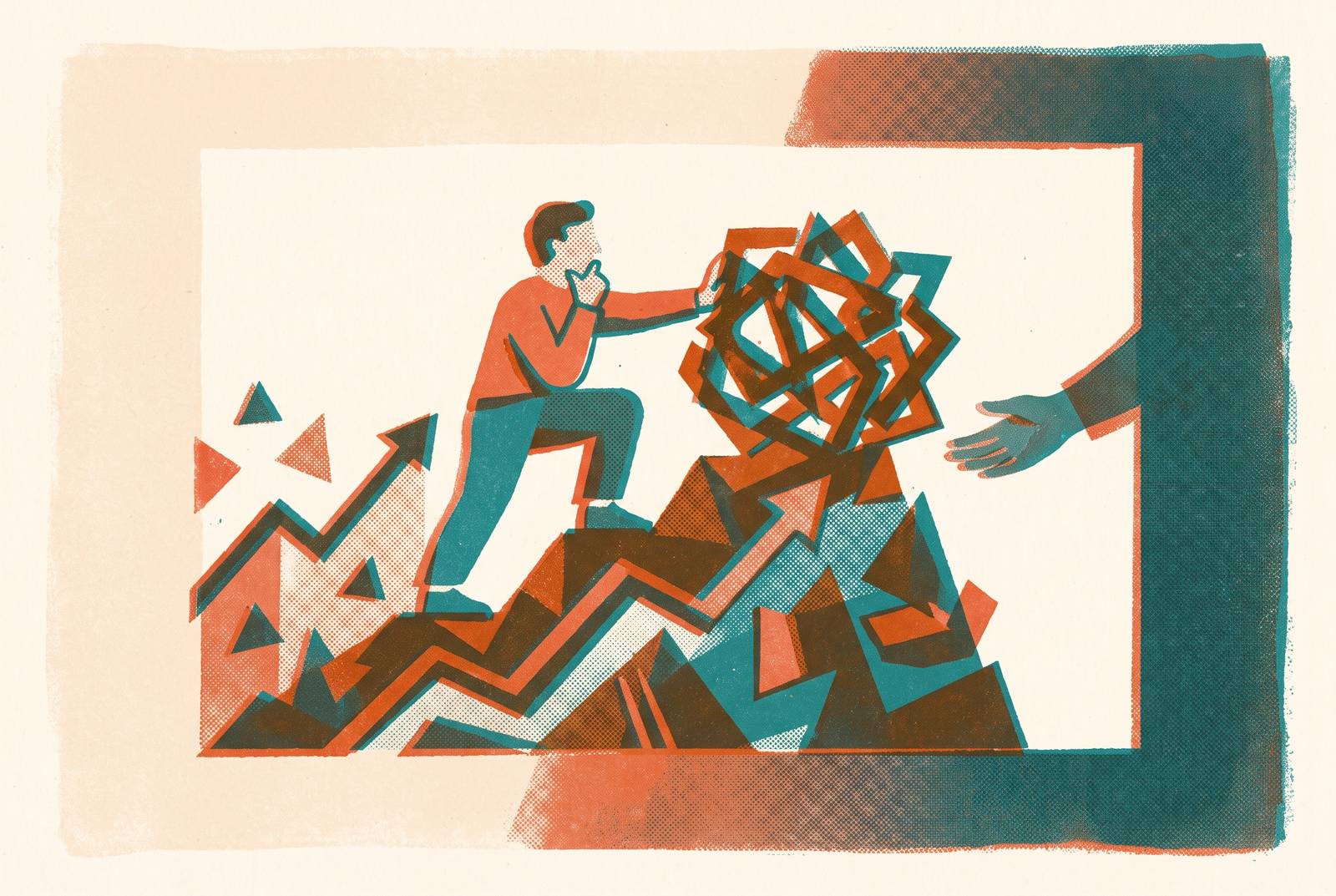
Productive struggle in math learning is about the line between difficulty that builds understanding and difficulty that stops learning. The goal is to recognize when a learner’s effort is doing useful cognitive work, then offer help without taking that work away. That judgment matters for teachers, students, and the AI tools that more and more often sit between them.
Why "productive struggle" has been hard to act on despite being widely endorsed
For years, those in mathematics education have backed productive struggle without agreeing on what teachers should look for. NCTM, the MIND Research Institute, and others have defined it through different ideas, including cognitive demand, perseverance, and habit of mind. A student can persist without reasoning, just as a demanding task can leave a student with no useful way to begin.
Young et al. (2025) examined the mathematics education literature and found a revealing imbalance. Definitions consistently emphasized cognitive demand, deeper understanding, and effortful engagement, but paid much less attention to ingenuity, mathematical relationships, and student-centered learning. Their proposed unified definition describes a student-centered process in which students put effort into cognitively demanding tasks that call for persistence, ingenuity, and deeper mathematical understanding. Teachers are being asked to support something they cannot yet reliably identify, much less assess.
What productive struggle actually does inside a learner's mind
Working out a solution requires a student to construct understanding. Students who work out their own solution methods learn the content better than those taught to follow procedures. The effort involved in making sense of the problem helps encode understanding more durably.
When teaching overemphasizes procedural steps, it can reduce students’ opportunities to reason and make sense of mathematical relationships. The immediate work may become easier while the opportunity to develop understanding narrows. This can create opportunity gaps in who gets to do the demanding intellectual work. A smoothly completed page is therefore not enough to establish that the student has learned deeply.
The learning environment also affects how much that effort delivers. The IXL spaced-learning study found that spaced practice had its largest benefit when students were engaged in productive struggle. Difficulty and spacing worked together, rather than acting as separate ingredients with unrelated effects. That finding gives productive struggle a more specific role than simply encouraging students to try harder. It belongs in how practice is planned, so that effort builds understanding that lasts.
What unproductive struggle looks like and why it is easy to miss
Yet effort only has that value when the student has something to work with. For productive struggle, students need relevant prior knowledge and conceptual tools. Without them, the same task can become an obstacle. Difficulty is relative to the person doing the work.
The observable shift is often from engagement with a problem to withdrawal from it. Frustration can accompany productive effort, so an unhappy expression alone is not a diagnosis. More concerning signals include task avoidance instead of repeated attempts, disengagement from the problem itself, and the loss of any strategy or direction. A learner who is trying another approach is in a different position from one who is passively rereading with no idea what to do. Both, unfortunately, can look like a student staring at a worksheet.
Khalil et al. described productive struggle as a variable concerned with the emotional aspect of mathematics teaching and learning, and reported students’ satisfaction with teacher support. That does not make satisfaction a measure of cognitive progress. Time spent, visible effort, and mood each reveal something, but none alone distinguishes deep engagement from being completely lost.
How teachers can read the line in real classroom conditions
Reading that difference requires evidence about thinking, gathered over time. Formative assessment gives teachers a way to notice when a student is genuinely stuck and use that information to shape instruction. Young et al. (2025) identified observable and measurable classroom indicators of productive struggle, making the concept less dependent on intuition.
Before a lesson, teachers can establish whether students have the prerequisite tools. During the lesson, they can attend to behavioral and emotional signals as students work. Afterward, data on how students did can help teachers plan the next task or see where their teaching needs to change. These are different intervention windows, because a missing foundation and a momentary loss of direction call for different responses.
Stanford Graduate School of Education’s findings from a large randomized controlled trial of Tutor CoPilot make the value of support for the intervener concrete. Students whose tutors had access to the tool were 4 percentage points more likely to master math lesson topics. Tutors without it more often gave away answers or offered generic encouragement. Structured support can change decisions at the moment help is offered. That matters especially when a teacher is managing many learners whose signals are subtle and student-specific.
How AI assistance, when uncontrolled, moves students across the line without anyone noticing
On-demand AI makes that already hard judgment harder in a different way. A student can now remove the challenge before a teacher has a chance to see what it was doing. The most tempting moment to request help may be exactly when a problem demands effort that the student could successfully supply. In that case, assistance converts productive struggle into unproductive ease.
A study of chess learners illustrates the risk. Learners who could ask for AI help whenever they wanted improved less than half as much as those who got help only when the system provided it automatically. Those with on-demand access also did far fewer practice sessions. Surveys after the study showed that clicking for help made them feel they had achieved less and made training feel less rewarding. The study concerns chess rather than math, but it sharpens the design question about who controls the timing of help.
The objection is not that every obstacle deserves protection. AI can reduce surface-level barriers, including formatting and decoding, that are not the cognitive work an exercise is meant to develop. Help starts to do harm when it takes over the reasoning the learner needs to practice. From a teacher’s vantage point, a student requesting necessary help can look identical to one outsourcing a solvable challenge. The help button does not announce which kind of help it has just provided.
What thoughtful AI design looks like when it preserves rather than bypasses the struggle
Better answers are only part of the design work, which starts with when help comes and what form it takes. Emerging research published on arXiv in 2026 proposes reinforcement-learning approaches that control when AI assistance becomes available, delaying access until students have genuinely attempted a problem. An attempt matters because it gives the learner a chance to do the cognitive work before assistance enters. Delay alone, however, is not the goal if the student has no useful way forward.
Feedback can also expose a breakdown without supplying the solution. In an AP Statistics classroom example, class-level grading analytics showed teachers when the majority of students had missed the same concept, making the need for reteaching visible. In AP writing, using separate evaluators for thesis, evidence and reasoning, and sophistication can show more precisely where work is weak than a single judgment of right or wrong. Across these settings, the useful distinction is between diagnosing thinking and replacing it.
Passionfruit Learning takes this approach with AI-powered grading and knowledge gap detection that aim to find out what each student knows beyond which answers they get right or wrong. Its AI-generated practice questions and real-time performance analytics make cognitive demand tunable around what a student has already mastered.
Support must also be able to recede. The adaptive scaffolding literature supports gradual fading guided by strong pedagogical expertise, while warning that excessive scaffolding weakens cognitive independence. The design test is therefore not just whether assistance gets a student through the current task. It is whether that assistance leaves room for the student to do more of the thinking.
How students can use this line to manage their own practice
Students can make this judgment themselves without waiting for a teacher to work out what every pause means. If you feel stuck but can form a hypothesis about what might work, you are likely still in productive territory. If you have no strategy and are only rereading the problem, the struggle has probably stopped paying its way.
That judgment gives help-seeking a purpose. On a problem at the edge of your current ability, delaying an AI request gives your own reasoning a chance to develop. On a problem far beyond your current tools, getting oriented quickly is appropriate. The decision depends on whether further effort has a direction.
Spacing makes this approach more sustainable. Rather than trying to settle every hard topic in one sitting, distribute review across sessions so that challenging skills return after a gap. For AP and SAT preparation, feedback then needs to go beyond giving the correct answer and explain where reasoning broke down. Many students struggle because of mistakes they never fully understood, even when they put in the effort. A practice session becomes more useful when it identifies what the next session needs to address, instead of ending with a score and an unresolved mystery.
What it takes to build a classroom — or a study habit — where the line stays readable
For that cycle to last, the tasks themselves must support it. Carefully designed challenging tasks are the foundation of productive struggle. A learner needs enough knowledge to enter the problem and enough demand to have something worth figuring out. Because those conditions change with the student and the task, the line cannot be fixed once for a whole classroom or an entire study plan. It has to remain adjustable.
Students also need to feel that an unsuccessful attempt is expected and recoverable. Otherwise, they may avoid the struggle before it has any chance to become productive. The Bellwether Institute’s June 2025 report identifies feeling safe, supported, and capable of taking risks as factors in whether ease enables learning or becomes a shortcut with a hidden cost. It describes productive struggle as a tunable dial, which captures the challenge of knowing how far to turn it. Making a task harder is not in itself better than making it easier.
The ability to make those adjustments is not equally distributed. AI-powered personalization holds promise for students with the largest skill deficits, but access disparities and teacher readiness remain real barriers. Even well-designed tools need those conditions to be in place, just as students who are determined to learn still need prerequisite knowledge. A sustainable classroom or study habit therefore depends on attention from the student, the teacher, and the tool. The essential skill is recognizing whether difficulty is still producing thought, or has begun to replace it with confusion.
Sources
- Spaced Learning Supports Productive Struggle in an Online Learning Platform
- Productive Struggle: The Future of Human Learning in the Age of AI
- www.ijemst.net What Exactly is the Productive Struggle? Lessons Learned from a
- What Exactly is the Productive Struggle? Lessons Learned from a Content Analysis of the Mathematics Education Literature
- (PDF) Productive struggle in mathematics: Utilising challenging tasks to establish richer mathematical learning experiences
- Full article: How do students evaluate their teachers’ support for productive struggle in learning mathematics? A mixed-methods study
- The Effortless Trap: Productive Struggle, AI, and the Illusion of Learning