AP Calculus BC Last-Week Cramming Plan
Focus your final week on series and integration, where the exam separates high scorers.

One week left and everything to review. That's the exact spot where most AP Calculus BC students land right now, staring at ten units of material and a calendar that only has seven boxes left on it. The instinct is to panic-review everything a little bit, which in practice means reviewing nothing well. The exam's own score data resolves that paralysis, because it tells students exactly where points are won and lost across the population, which turns "review everything" into "review this, in this order."
By this point in the year, AB-level foundations are mostly locked in. Limits, derivatives, basic applications: that ground has been covered for months. Re-reading those chapters one more time has a much smaller payoff than drilling the specific spots where the exam reliably separates scores. The final seven days work best as a performance phase. That means mixed practice instead of passive review, targeted repair of known weak spots, and repeated FRQ attempts instead of one more pass through the textbook. The goal isn't to learn new calculus this week. The goal is to convert what's already known into points under exam conditions.
Where Students Succeed and Struggle in the 2026 Score Data
The 2026 AP Calculus BC exam was taken by roughly 171,000 students, a self-selected and mathematically strong group to begin with. That matters, because it means the difficulty signal buried in the unit-level data reflects real mathematical difficulty, not a weak test-taking pool dragging the numbers down. When a unit looks hard in this data, it's hard for students who are already good at calculus.
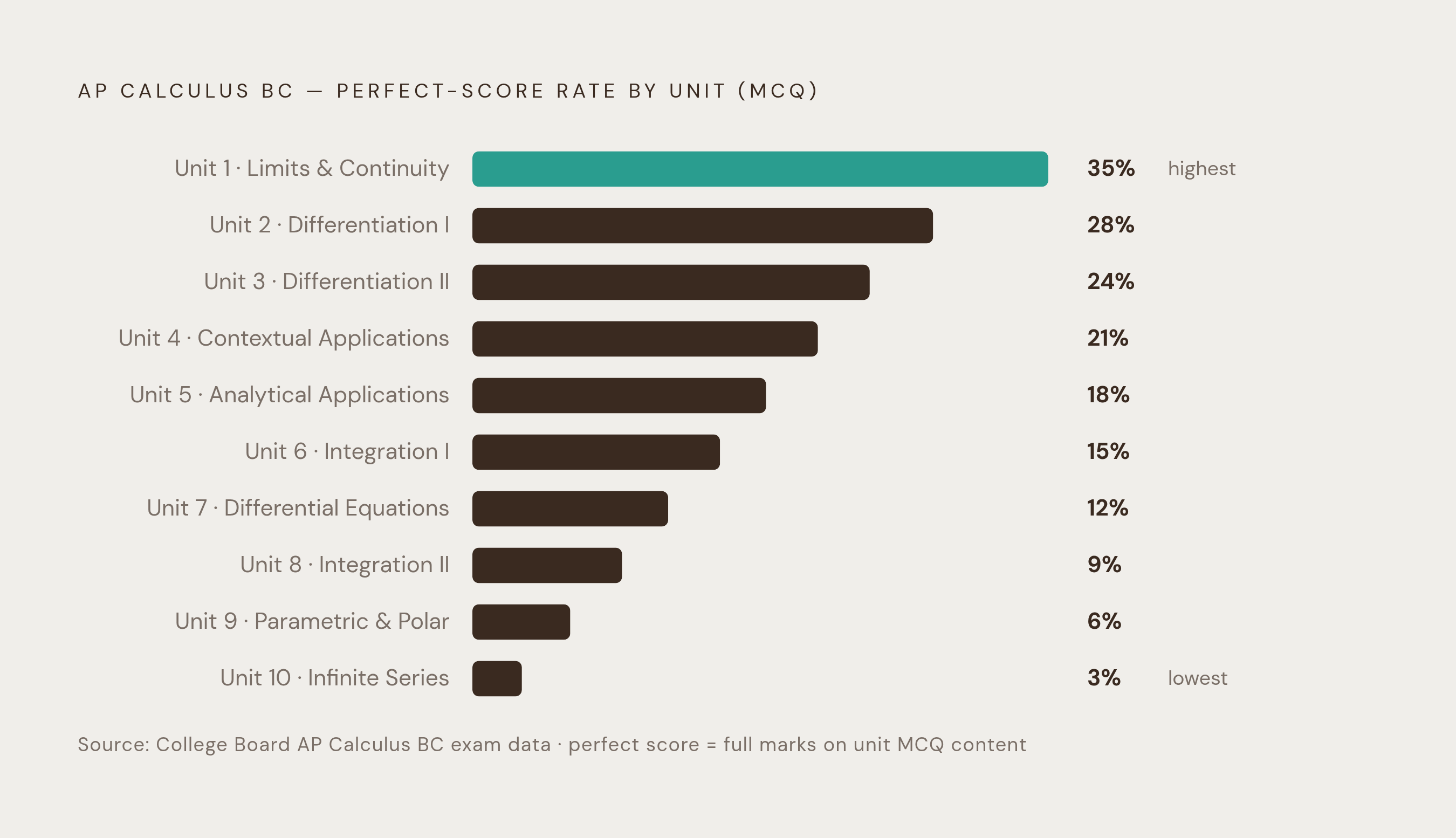
The multiple-choice results make the contrast obvious. On Unit 1 (Limits and Continuity), 35% of students earned every available point, the highest mastery rate of any unit on the exam. Units 4 and 5 (Applications of Differentiation) told a similar story: students who ultimately scored a 3 or higher answered most of these questions correctly. Those are the settled units, the ones where strong students are already clearing the bar.
Unit 10 (Infinite Sequences and Series) sits at the other end of the spectrum. A perfect score on the Unit 10 MCQ content was rare, with only 3% of students pulling it off. The gap between Unit 1's 35% and Unit 10's 3% is the clearest line in the entire dataset.
The free-response data draws the same line, just in a different format. FRQ 2, the polar curve question tied to Unit 9, concentrated its hardest points in Parts C and D, and those parts consistently separated the 5s from everyone else. FRQ 5, which covered area, volume, and perimeter through integration, spread students across all three upper score bands: 3s, 4s, and 5s each landed in different places, with the hardest segment, Part C, earned mainly by the 5s. FRQ 6, built on Unit 10 and asking students to work with a Maclaurin series, produced the sharpest 4-versus-5 split on the entire exam. Students earning a 3 could typically write two terms of a series. Students earning a 4 pushed further and wrote all four terms. The 5s pulled ahead on other parts of the same question, on top of that.
None of this would matter as much if the exam weighted sections unevenly, but it doesn't. MCQ and FRQ each count for half the composite score, and the bar for a 5 sits high enough that partial credit on the exam's hardest questions carries outsized weight. A few extra terms of a series, written correctly, can turn a 4 into a 5.
Unit 10 (Series and Sequences): the highest-leverage topic for last-week cramming
Unit 10's difficulty is specific and fixable, which makes it the best use of a short week. The difficulty doesn't come from years of accumulated gaps the way struggles with derivatives sometimes do. It comes from a single cognitive shift: learning to recognize which convergence test applies to which series, and learning to manipulate power series algebraically instead of just computing with them.
Students lose points on Unit 10 for a very specific reason: they pick the wrong convergence test. Applying the ratio test where the exam wants the alternating series test wastes time and earns zero justification points, even if the final answer happens to be right. What fixes that is building a decision flowchart instead of memorizing six tests in isolation. If a series has factorials or exponentials, reach for the ratio test. If it alternates, check the alternating series test conditions. That kind of structured decision-making is trainable in days, not months.
The same is true of the four core Maclaurin series: e^x, sin x, cos x, and 1/(1-x). These appear repeatedly across FRQs and MCQs, built into other functions through substitution, differentiation, or integration. A student who has these four memorized cold, ready to manipulate on command, has already closed a measurable chunk of the gap between a 4 and a 5 on FRQ 6.
The FRQ 6 data spells out exactly where that gap lives. Moving from a 3 to a 4 meant going from two terms of a derivative series to four terms. Moving from a 4 to a 5 meant writing all three terms of a related function's series and earning the convergence justification points in Part C. Both of those are drillable skills with a clear target, not vague mastery goals. Which raises the obvious next question: if Unit 10 earns the biggest slice of the week, what happens to everything else?
Triaging the remaining units when time is limited
Not every student should pour the entire week into series. A student with real gaps in integration (Units 6 through 8) faces a different calculus, because those units carry more total exam weight and appear across multiple FRQs. The data supports heavy investment in Unit 10, but it doesn't license ignoring the rest of the exam.
Integration earns the second priority slot. Within that block, two BC-only additions deserve the most attention: integration by parts and partial fraction decomposition. Both appear in MCQ and FRQ contexts, and drilling these two techniques specifically covers more ground, faster, than re-reviewing all of integral calculus from scratch.
Unit 9, covering parametric equations, polar curves, and vectors, takes the third slot. These topics are BC-only and appear often enough that a shaky setup on a polar area integral turns into a predictable, avoidable point loss. Being able to set that integral up without hesitation is worth more than it might seem, given how often the exam returns to it.
Units 1 through 5, the limits, derivatives, and applications that make up the AB core, land at the bottom of the last-week priority list for a student with stable foundations. These still deserve a speed-review pass: quick, rapid-fire MCQ drills to keep the reflexes sharp. They don't deserve extended cramming time, because the 2026 data already shows strong students clearing these units comfortably.
One qualifier matters here: this ranking is the right default, but it's a default, not a mandate. A student whose actual weak spot is polar derivatives rather than integration should shift time accordingly. The ranking sets the starting point. A personal diagnostic sets the adjustment.
A day-by-day structure for the seven days before the exam
The week should be built around the same priority order the data supports: series and BC-only material front-loaded while energy and time are both highest, integration occupying the middle stretch, a speed-review of AB foundations toward the end, and FRQ practice running underneath all of it from day one.
Unit 10 deserves the largest single block of time in the week. That block should include building the convergence test decision flowchart, memorizing the four core Maclaurin series until they're automatic, and drilling FRQ 6-style problems until the series manipulation stops feeling effortful. Units 6 through 8 take the second-largest block, with integration by parts, partial fractions, improper integrals, and arc length as the focus, and procedural fluency, meaning clean, visible setup work, as the goal rather than speed alone. Units 1 through 5 get the lightest block of the week: short, fast MCQ drills, plus attention to the exact phrasing the exam wants for Mean Value Theorem justifications and extrema arguments, since those are the communication points students lose even on material they understand perfectly well.
These proportions aren't fixed. A student who already tests strong on polar curves can shift that time toward integration instead, and a student shaky on derivative applications can borrow a little time back from the AB review block. The diagnostic result should set the dial.
A few mechanics apply no matter how the week is divided. Time is better spent reviewing wrong answers than grinding out new ones, since understanding why an answer was wrong teaches more per minute than another fresh attempt. A running error log, tracking what went wrong, what the fix is, and what to do differently next time, keeps that review from evaporating day to day. FRQ practice should start on day one and continue every day afterward, because FRQs blend multiple topics into a single question, require visible steps, and build partial-credit habits that multiple-choice practice simply doesn't touch. Sleep belongs in the plan too: math accuracy drops sharply under fatigue, and a well-rested student on exam morning will outperform a tired student who squeezed in two extra hours the night before.
The 2026 exam runs on a hybrid format, with multiple-choice delivered digitally and free-response still on paper. Practicing the mental switch between a screen and a pencil is its own small skill worth rehearsing at least once before exam day, not just reviewing the math content.
Approaching FRQs to earn partial credit reliably
Partial credit is baked into how FRQs are scored, and that structural fact makes communication strategy just as important as getting the math right. A student who sets up the correct integral but fumbles the arithmetic still earns the setup points. A student who writes the correct final answer with no supporting work earns nothing. Those two outcomes can reflect the same level of calculus understanding and still land on opposite ends of the score range.
The 2026 FRQ scoring commentary spells out that graders reward constructing an argument, not just producing a number. Justifying convergence, interpreting a definite integral in context, evaluating a slope field: these are reasoning tasks, and they're graded as reasoning tasks. On the Maclaurin series FRQ specifically, the points separating 4s from 5s sat in Part C, the convergence justification, and Part D, writing out all the terms of a related series. Both of those demand written mathematical reasoning.
A few habits translate that insight into points. Writing out the full integral or derivative expression before evaluating it matters, since the setup step carries its own credit on most rubrics, separate from the final number. Notation needs to stay clean and consistent throughout, limits of integration, dx or dθ, proper series notation, because graders can't award points for work they can't follow. Convergence justifications need all three pieces every time: name the test, state its conditions, and state the conclusion. Leaving out any one of the three risks losing credit even when the math behind it is correct. On calculator-active questions, the setup should be written out in full and the calculator result recorded to three decimal places, since the rubric checks the process behind the number as much as the number itself.
The most efficient way to build these habits in a single week is working released past exams under real timed conditions, then self-scoring against the official scoring guidelines. That process doesn't just catch wrong answers. It catches wrong communication, which is the harder habit to unlearn and the one the 2026 data shows actually separates the score bands.
Why a diagnostic before day one changes the rest of the week
The population-level data makes one thing clear for every student: Unit 10 is hard, and the FRQ communication points are where scores actually separate. What that data can't do is tell any individual student whether their personal weak spot is convergence tests, Taylor series notation, or setting up a polar derivative. Those are three different problems requiring three different kinds of practice, and a plan built purely on population averages will miss whichever one applies personally.
That's the case for taking a diagnostic before day one even starts. A student who identifies their two or three highest-point-loss units before diving into review avoids the single biggest time trap of the entire week: spending precious days re-studying material that's already solid. Studying strictly in textbook order, unit one through unit ten, treats every topic as equally urgent, when the 2026 data makes clear that some units are already settled and others are where the exam is actually won or lost. The population data sets the starting order. A personal diagnostic is what turns that order into a plan built for the student actually taking the exam.