Juggling AP Bio, AP Calc BC, and APUSH Study Schedules
Three back-to-back AP exams demand different study strategies, not equal time.
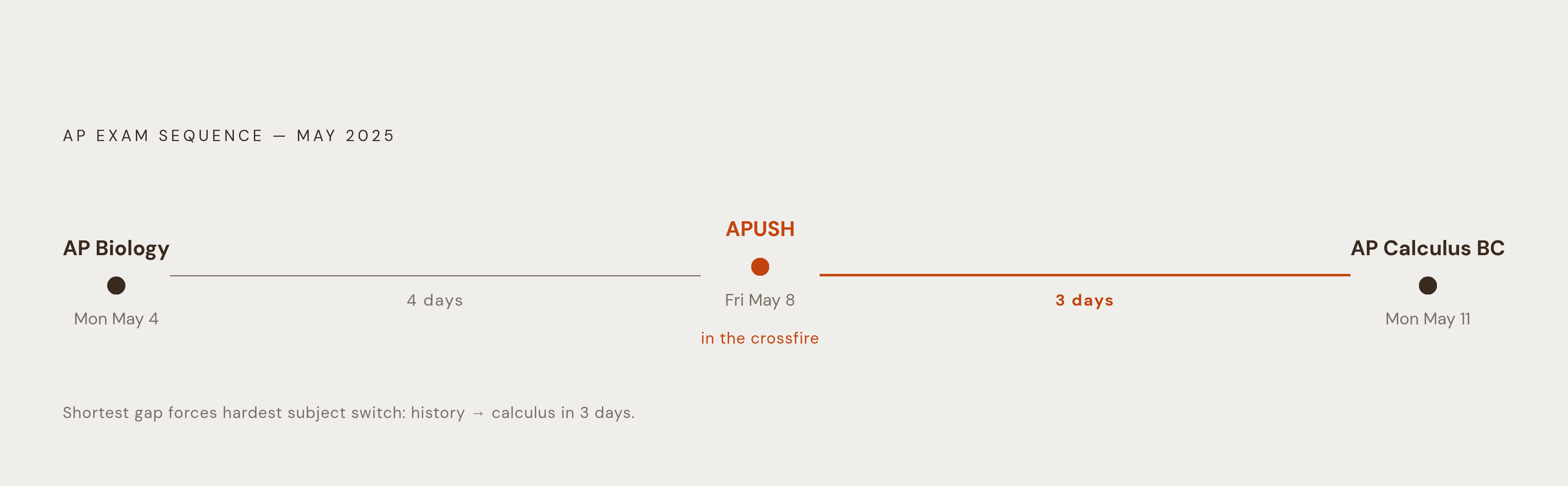
AP Biology falls on the morning of Monday, May 4, 2026. APUSH follows four days later, on the morning of Friday, May 8. AP Calculus BC closes the stretch on the morning of Monday, May 11. Lay those three dates next to each other and the problem becomes obvious: there is no week where a student can put two subjects aside and just focus on one.
Look at the order again. Bio, then APUSH, then Calc BC. That's seven days between Bio and Calc BC, and APUSH sits right in the middle of that week, not conveniently after both. So a student finishing a biology exam on Monday has four days to turn around and produce a document-based essay on Friday, then three more days to shift from historical argument writing back into derivatives and series convergence for Monday.
That sequence rarely lines up with how students rank the exams in their head. Most students walking into junior or senior year assume Calc BC is the beast and APUSH is the one you can cram for because you've been sitting in that class since September. The calendar doesn't care about that assumption. It places the exam many students underrate, APUSH, right in the crossfire between two technical, format-heavy tests. Treating these three subjects as one undifferentiated block of "AP studying," split evenly across the weeks leading up to May, misreads the problem from the start. The three exams need different kinds of time, in different amounts, on different days, and the calendar makes that non-negotiable.
Exam Format and the Studying It Requires
Each of these three exams rewards a different kind of thinking, so an hour spent on one doesn't transfer to the others the way students often hope.
Start with Calc BC. Its score splits evenly between multiple choice and free response, and both sections enforce a strict split between calculator-allowed and calculator-free work. That alone means practice has to mirror that structure rather than just working problems in whatever order a textbook presents them. BC-only content, meaning series, parametric equations, polar functions, and vector functions, appears in roughly 2 of the 6 free-response questions on recent released exams, which is specifically what trips up transfer students and self-studiers. Anyone who came up through an AB course, or who is learning BC material independently, tends to carry a gap sitting exactly there, in a predictable location that diagnostic testing can catch early.
APUSH runs on a completely different engine. The free-response section, which covers the short-answer questions, the document-based question, and the long essay question, makes up a majority of the total score, and the DBQ alone carries a large chunk of that on its own. The multiple-choice section isn't a memory test either: it's 55 questions, every one anchored to a primary source, an image, a map, or a dataset. A student who has memorized a long list of historical facts but never practiced reading a political cartoon under time pressure will stall out on questions that look nothing like a flashcard. The DBQ rubric spells out exactly where its 7 points come from: thesis, contextualization, evidence pulled from the documents, evidence from outside the documents, sourcing, and complexity. That's a rubric built around a writing skill, not a measure of how much content a student can recite. The LEQ gives students a choice among 3 prompts. The DBQ gives no choice at all, just 7 documents and the expectation of a coherent argument built from them.
AP Biology looks, on the surface, like the most straightforward content subject of the three. Both sections lean hard on data interpretation, reading graphs, following experimental design, and working through quantitative reasoning, so students who prepare for Bio as a vocabulary-and-process-recall subject miss what actually matters. Inside the free-response questions, quantitative sub-parts like Hardy-Weinberg calculations, chi-square goodness-of-fit tests, and water potential problems are worth one or two points each, and they're some of the most commonly dropped points on the exam, simply because students don't walk in expecting math inside a biology rubric. On top of that, 2026 brings a hybrid digital format: multiple choice runs in the Bluebook app, and free-response prompts appear in Bluebook too, but students write their actual answers by hand in a physical booklet. That's an interface a student has to practice, not something that takes care of itself through content review.
Why allocating time by perceived difficulty almost always misfires
A felt sense of difficulty is a terrible map for where study hours should go, because what feels hard in the moment and what a score report actually says are frequently two different exams.
A coached student scored a 4 on Bio, a 2 on APUSH, and a 3 on Calc BC. Ask that student which class felt hardest all year: the honest answer is almost certainly the one with symbolic notation and a reputation for being hard. But the score gap says otherwise. The subject that actually needed the most attention was the one that felt the most finished, APUSH, precisely because a year of lecture notes creates a false sense of readiness.
That's the trap built into APUSH specifically. Content has been covered in class since the fall, so it feels reviewable: flip through notes, reread a timeline, and call it studying. But with FRQs carrying roughly 60% of the score, reviewing content answers a question the exam isn't really asking. The exam wants argument construction under a rubric, built from unfamiliar documents, on the spot. Content recall is necessary but nowhere near sufficient, and that gap between "I know this material" and "I can turn this material into a scored DBQ" is where APUSH prep quietly fails for a lot of otherwise strong students.
The fix starts with data, not instinct. A full-length practice exam taken early, before weeks of review have already colored a student's sense of their own strength, produces a score gap across all three subjects that functions as an actual allocation signal, rather than a guess based on which class gives the most homework.
Setting up the diagnostic baseline that drives hour allocation
Because a study schedule built before anyone knows where the gaps actually sit is a schedule built on guesswork, the first task for a student juggling these three exams is a practice exam in each subject, not content review.
A full-length or section-based diagnostic in Bio, APUSH, and Calc BC, taken early in the prep window, shows strengths and weaknesses before a single hour of the weekly schedule gets planned. Skipping this step and jumping straight into review means building a plan around assumptions instead of evidence, and those assumptions produced the 4/2/3 mismatch described above.
Conditions matter here as much as content. The diagnostic needs to be timed, and it needs to mimic exam-day conditions as closely as possible: the Bluebook interface for Bio, the calculator and no-calculator split for Calc BC. A student who takes an untimed, open-notes practice test learns very little about how they'll perform at 8 a.m. on May 4 with a proctor watching the clock. Score accuracy depends on the conditions matching reality.
Once those three scores come back, they become the main input for how weekly hours get split. The subject sitting furthest below its goal score claims the largest share of study time, not an equal third of the calendar. That's a different approach than most students default to, which is dividing the week into three roughly equal chunks regardless of where the gaps actually are.
One part of this process is easy to skip and shouldn't be: the diagnostic needs to happen again every four to five weeks. A second full-length practice exam confirms whether the gap identified in week one is actually closing. If it isn't, that's the signal to reallocate hours again, rather than trusting that the original plan is still working just because it felt productive.
Building the actual weekly schedule around exam order and score gaps
With diagnostic scores in hand, the schedule itself needs to do three things at once: weight time by score gap, keep all three subjects moving every week, and ramp up intensity for Bio and APUSH as May 4 and May 8 get closer.
Score gap drives the proportions. If the diagnostic shows APUSH sitting well below goal while Bio and Calc BC are closer to target, APUSH claims the largest block of weekly hours until that gap narrows. That doesn't mean abandoning the stronger subjects: it means the weakest subject doesn't get quietly starved just because its exam happens to fall in the middle of the calendar, which is the failure mode the May 4 / May 8 / May 11 sequence invites if a student isn't paying attention.
Rotation matters as much as proportion. Spending a full week locked into one subject, then moving to the next, sounds efficient but backfires here: by the time a student circles back to the first subject, a week or more has passed with zero contact, right before an exam that needs sharp recall. Rotating two or three subjects every few days instead keeps all three active in working memory at once. In the six weeks before the Bio exam specifically, rotating subjects every two to three days consistently beats a sequential "finish Bio, then start APUSH" approach, because the sequential version guarantees a cold start on whichever subject got pushed to the back of the line.
Calc BC needs its own rhythm inside that rotation. Calculus runs on clear thinking, not stamina, so two shorter, focused sessions on separate days beat one long, exhausted block. If more total time is needed for Calc BC in a given week, adding a third short session works better than stretching any single session longer.
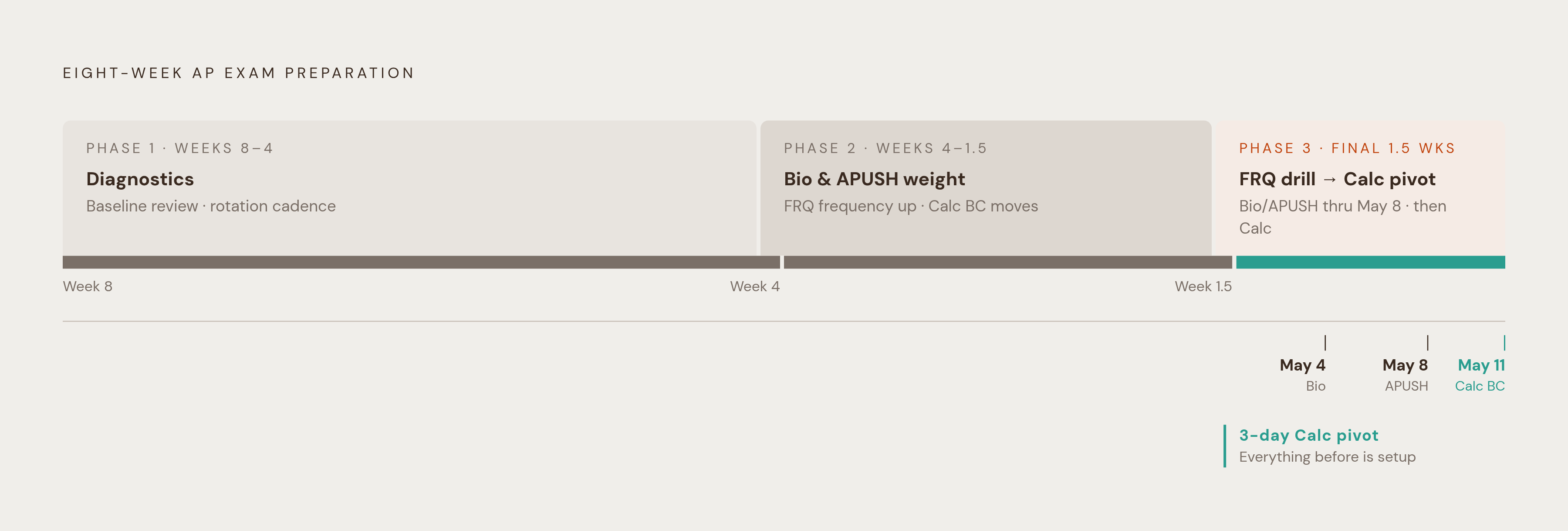
All of this fits into three rough phases, built around the exam calendar rather than a fixed number of weeks:
Phase one runs from roughly eight weeks out through about four weeks out. This is diagnostic territory: take the baseline exams, review the highest-priority units in each subject, and settle into a rotation cadence that will carry through the rest of the prep window.
Phase two covers four weeks out through about a week and a half before the first exam. Weight shifts toward Bio and APUSH, since those are the first two exams on the calendar. FRQ practice frequency increases in both, while Calc BC keeps moving forward on series work and Part B free-response practice so it doesn't go cold.
Phase three is the final stretch, from about a week and a half out through exam week itself. Bio and APUSH FRQ drilling intensifies through May 8, and then the entire plan pivots, fully, to Calc BC for the short three-day window between APUSH on May 8 and Calc BC on May 11.
An eight-week timeline with at least two sessions a week of an hour or more, per subject, is a reasonable starting structure. Spread across three subjects, each one occupies the calendar at least twice a week, with the lowest-scoring subject from the diagnostic appearing more often than that.
Subject-specific priorities within each phase
Knowing how many hours go where only solves half the problem. Inside each subject, a handful of units and skills account for most of the available points, and finding those early saves a lot of wasted review time.
In Calc BC, AB foundations come first. Limits, derivatives, and integrals need to be solid before BC-only material gets dedicated attention, meaning Units 9 and 10 along with the BC-exclusive pieces embedded in Units 6 through 8. A student who's shaky on core AB mechanics and jumps straight into series or parametric functions compounds the original gap. For students already in the 3-to-5 score range, drilling series convergence tests in the final four weeks produces the largest FRQ gains of any single topic, which makes it a strong late-stage priority once the foundations are stable.
In APUSH, the DBQ is the center of gravity. It carries roughly 25% of the total score on its own, so mastering its rubric, thesis, contextualization, sourcing across multiple documents, outside evidence, and complexity, is the single highest-return use of study time in the entire subject. Content coverage still matters, but it doesn't need to be uniform: six of the nine historical periods appear far more often than the other three on the exam, so students working with limited time get more value concentrating there and reviewing the remaining periods at lighter depth. MCQ practice should use stimulus-based questions built around primary sources, not recall-style quizzes, since that's what the actual exam looks like. LEQ practice should center on argument structure, meaning claim, evidence, reasoning, and complexity, rather than trying to memorize more content, and choosing wisely among the three LEQ prompts on exam day is a skill worth rehearsing beforehand.
In Bio, data interpretation isn't a separate unit to schedule. It belongs inside every single study session, since both the multiple-choice and free-response sections lean on reading graphs, evaluating experimental design, and applying quantitative reasoning throughout. The quantitative FRQ sub-parts, Hardy-Weinberg, chi-square goodness-of-fit, water potential, deserve their own checklist, since these are small point values that get lost constantly simply because students don't walk in expecting math inside a biology prompt. And because 2026 brings the hybrid Bluebook format, with multiple choice on screen and free-response answers handwritten in a booklet, getting comfortable with that interface ahead of time matters. Downloading Bluebook and running at least one timed multiple-choice practice session inside the actual app is a concrete, specific step that pure content review will never cover on its own.
Why FRQ practice volume is the lever most students underuse
Accepting that APUSH's score depends 60% on free response, and that Bio's FRQs demand rubric-level precision down to the quantitative sub-parts, leads to an obvious next question: how does a student actually practice that much writing without waiting days for feedback on every attempt?
That's the real bottleneck. Writing a DBQ or a Bio free-response answer is only useful practice if the feedback comes back fast and lines up with the real scoring criteria. A student who writes three practice DBQs a month but waits two weeks to find out what went wrong in each one isn't building the skill fast enough to matter by May 8.
AI tools built to grade free-response answers against official College Board rubrics are changing that math. Teachers can now assign FRQ practice weekly, across a full class, without the grading pileup that used to make high-frequency writing practice impractical at scale. For a student juggling three AP exams on a compressed calendar, that shift matters directly: more attempts, graded against the actual rubric categories, mean more chances to close the specific gaps the diagnostic flagged in the first place, whether that's sourcing on a DBQ or a missed Hardy-Weinberg calculation on a Bio FRQ.